We’re looking for Australia’s finest portrait artists.
I showed my phone screen to Amanda, the sponsored post that had spliced its way into my Instagram feed. “They’re doing callouts for a new art show,” I said. “It doesn’t say, but… it’s got to be an Australian version of Portrait Artist of the Year.”
This was a show we were both avid watchers of, a UK series that stripped away the tackiness of reality TV and dedicated itself to the process of painting; a celebration of art and artists that welcomed professionals and newcomers alike.
“Oh wow. Yeah, I bet it is.”
“You should totally do it. This is 100 percent you.”
Amanda paused. “Only if you do it with me.”
And I paused too, and I looked at the post on my phone, and I gave my trademark non-committal response, the one that serves to temper the moment in a way that outwardly lets possibility linger, but really, is my mind making a hasty unspoken retreat:
“Yeah, maybe…”
Outwardly, it was yeah, maybe - inside, it was hell no. I couldn’t go on a TV show. There was no way. Me, I’m just a writer guy who made an Instagram account to house random dabblings of visual art in between, you know, being the writer guy. I wasn’t a real artist. There’s no way I’m ready enough, skilled enough, brave enough to subject myself to the pressures of a TV show that demands artists to perform and subjects them and their work to the scrutiny that follows.
But I saw all those qualities in Amanda. Art was her thing, always had been. Amanda has always been the artist - that’s how I knew her when we first met 18 years ago. Between the hundreds of illustrations produced in her professional career and the hundreds more produced for fan zines, friends, and her own interests on weekends, holidays and evenings, my wife is well and truly a capital-A Artist.
Yeah, maybe… And that, at least in that moment, was that.
Until a week later, when an email arrived in my inbox. The sender was Aimee, a producer at EndemolShine Australia. “I’ve had a look at some of your work online,” she said. “I’d love to chat with you about an upcoming TV series. I feel like it could be up your alley.”
Uh-oh…
I’m just a writer guy.
That was how, years ago, I had rationalised the purchase of an Apple Pencil, as a way to mark up manuscripts on my iPad. Saving the trees, one digital red underline at a time, as I proofed my way through PDFs of short stories and novels - written in and around my day-to-day of magazine production and content management - with starry-eyed hopes of publication.
When I wasn’t editing, I was writing. At least, there were attempts to do so. As any creative writer knows, sometimes the words just don’t come, and sometimes the mind wants to be anywhere else than in front of the screen, fruitlessly tapping away at a story that doesn’t want to be told. So it was more out of curiosity than anything else that I started wondering: how else can I use this Pencil?
Enter Procreate.
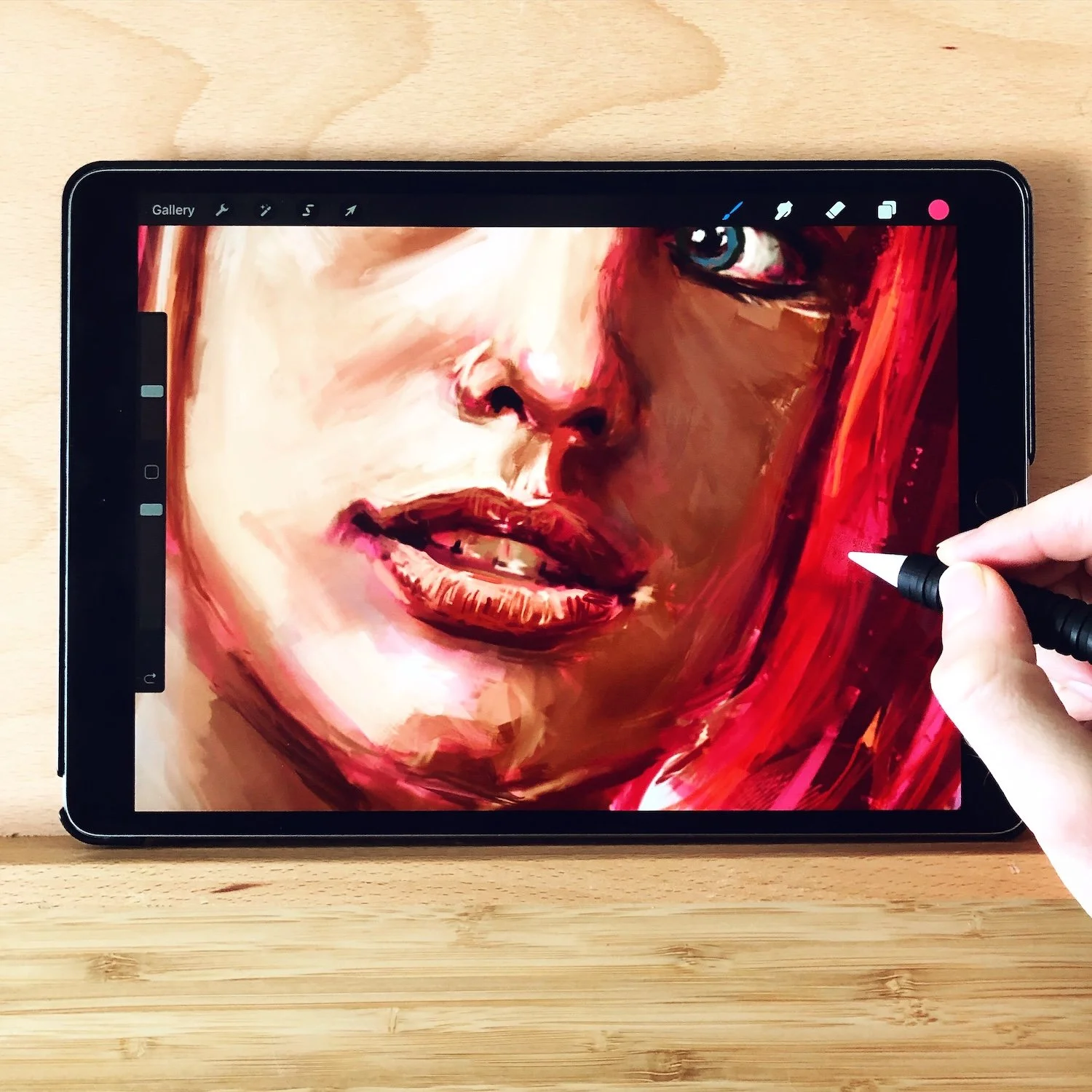
“Leeloo Dallas mul-ti-pass.”
The App Store’s digital darling and an Aussie tech success story, Procreate had exploded from its Tasmanian origins to become one of the defining iPad apps. A night-and-day comparison in UI minimalism to traditional behemoths like Photoshop, it strove to make digital art accessible, approachable. And hey, it was a one-and-done purchase, no monthly subscription. To buy it on a whim was too easy.
And so I did. When the words wouldn’t come, I had something to noodle away with using the Pencil, a digital scribble pad to play with brushes and colours and basically just mess around with nothing at stake.
That was how it started. Squiggles became faces, and faces became subjects. Photo references became clear goals: paint this face. Early attempts were as you’d expect, like the brain demands one thing but the hands feel like they’re wearing oven mittens. But that was the challenge. And as time went on, I found myself using Procreate less and less as an escape, and more and more as a primary destination. Words took a back seat. Art became my focus.
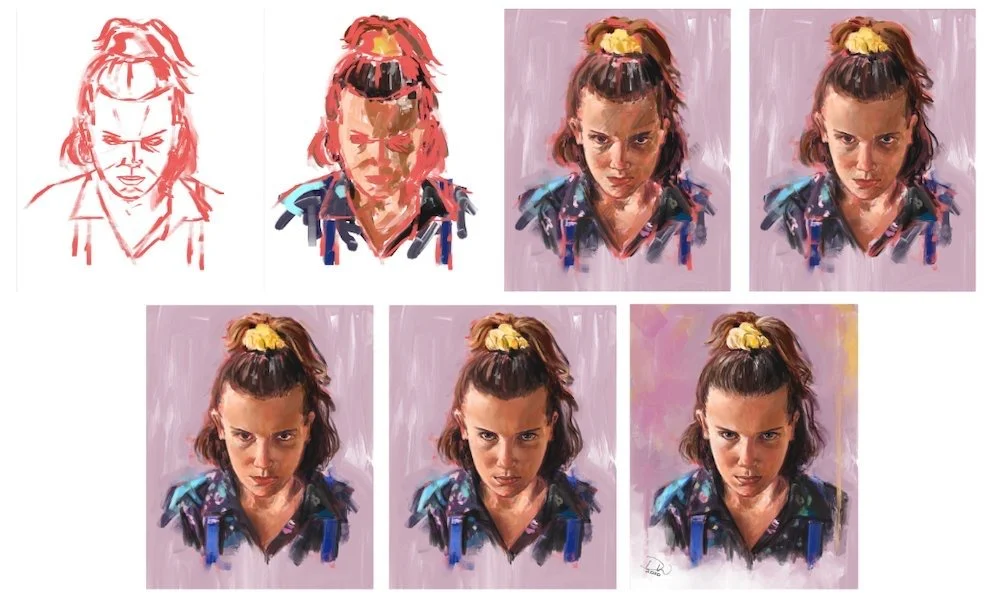
My digital painting process in 2020.
Years passed. An art Instagram account emerged. One post followed the other.
At some point the idea of doing traditional art started to creep in. With it came another challenge, another learning experience. An exercise in seeing what parts of the digital practice would carry over, and what conveniences would no longer serve (Undo! Liquify! Layers!).
Amanda gifted me a visual diary for my birthday. It was the subject of a see-saw relationship between being brave enough to use it and precious enough to not dare sully its pristine pages with my scribbles. But just as Procreate was a low-stakes entry point into digital art, the simple graphite pencil was my way to the physical page… and hey, if things got too terrible, it could always be erased…
I’d come to bring a sketchbook and mechanical pencil with me to work, doing sketches at lunch most days. I’d post these sketches to my Instagram stories, a there-and-gone way of releasing them into the world without the permanence, or attention, of a dedicated post. But gradually the pendulum swung, and traditional sketches started to find their way to my grid. From words becoming pixels, and pixels becoming drawings, graphite pencil was the new medium that I wanted to explore, and my Instagram slowly evolved to showcase each step of this journey online.
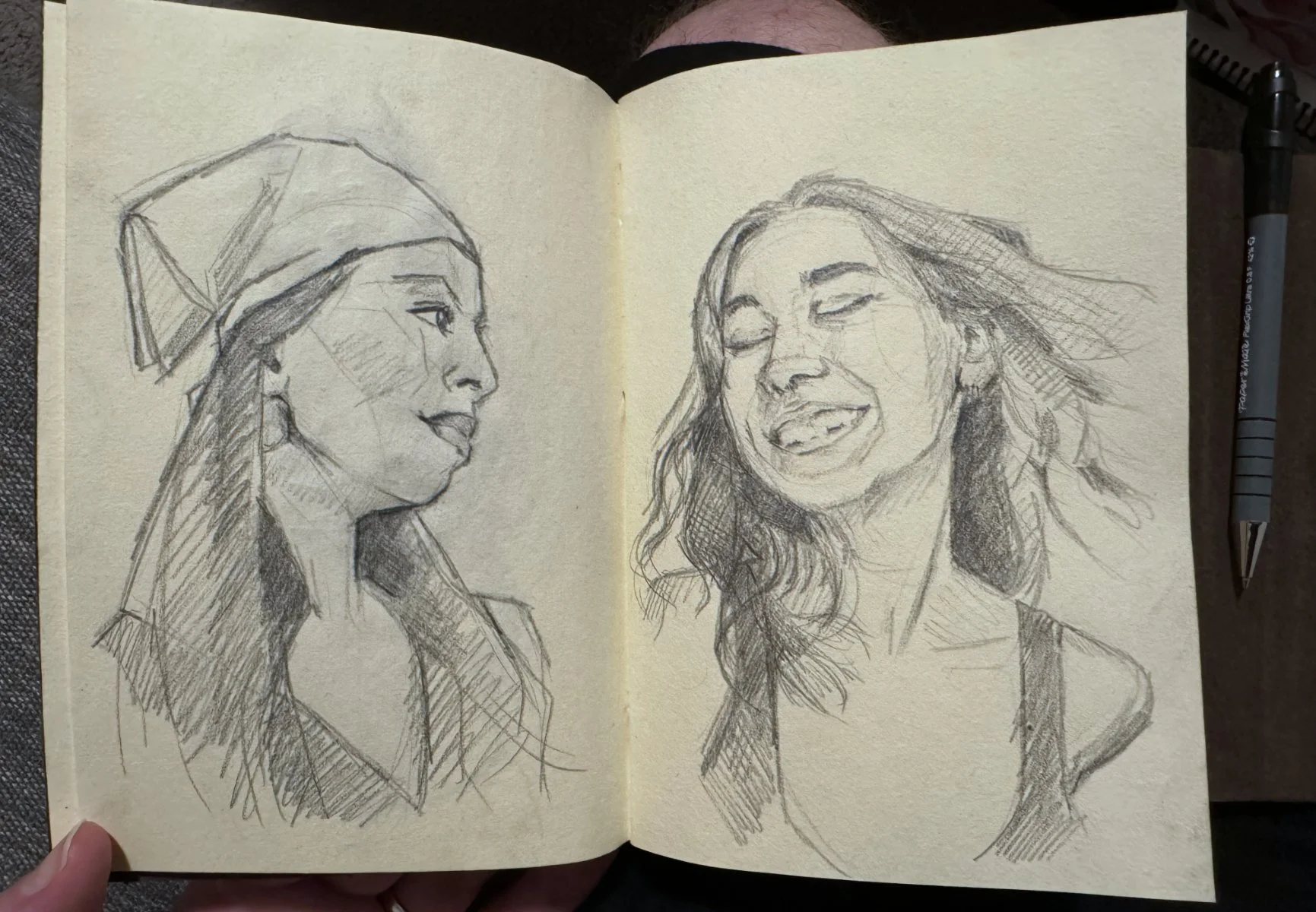
Some sketches from around 2023.
I sat looking at that email, rereading and unpicking every sentence. Agreeing to a chat with Aimee seemed like the least I could do, if for no further reason than to fulfil the curiosity her message had ignited. What would this process look like? What might happen?
A phone call was arranged. Aimee was immediately friendly and welcoming. The official title of the “upcoming TV series” in question was, at the time, still unannounced, but she said artists might know of it. “I think I can guess,” I said.
The call continued as I wandered out into the living area, to our old desk given second life as an art station - Amanda was working on a gouache painting, and every so often I’d build up the wherewithal to sit there with my pencils or charcoal. Aimee wanted to know more about my art journey, and I took her through a version not unlike the words recounted above. Discussion eventually turned towards support from friends and family. What did they think about my time spent making art?
“Oh yeah, well my wife’s an artist, so she’s been fully on board,” I said.
You could almost hear the casting agent cogs racing. “Did you say your wife also does art?”
To be continued…