“The sitter is right there. Why are they working from photos?”
It’s a common remark from viewers online, and perhaps a thought threading the live crowd of onlookers as they watch Portrait Artist of the Year’s contestants work on their pieces. The sentiment might range from curiosity, to dismay, to outright scorn, but at its heart is a simple question: why, in a setting that offers its artists a live model, do some choose to paint (or draw! #hierarchyofmaterials) from a digital reference?
To answer that, we first need to look at what Portrait Artist of the Year isn’t.
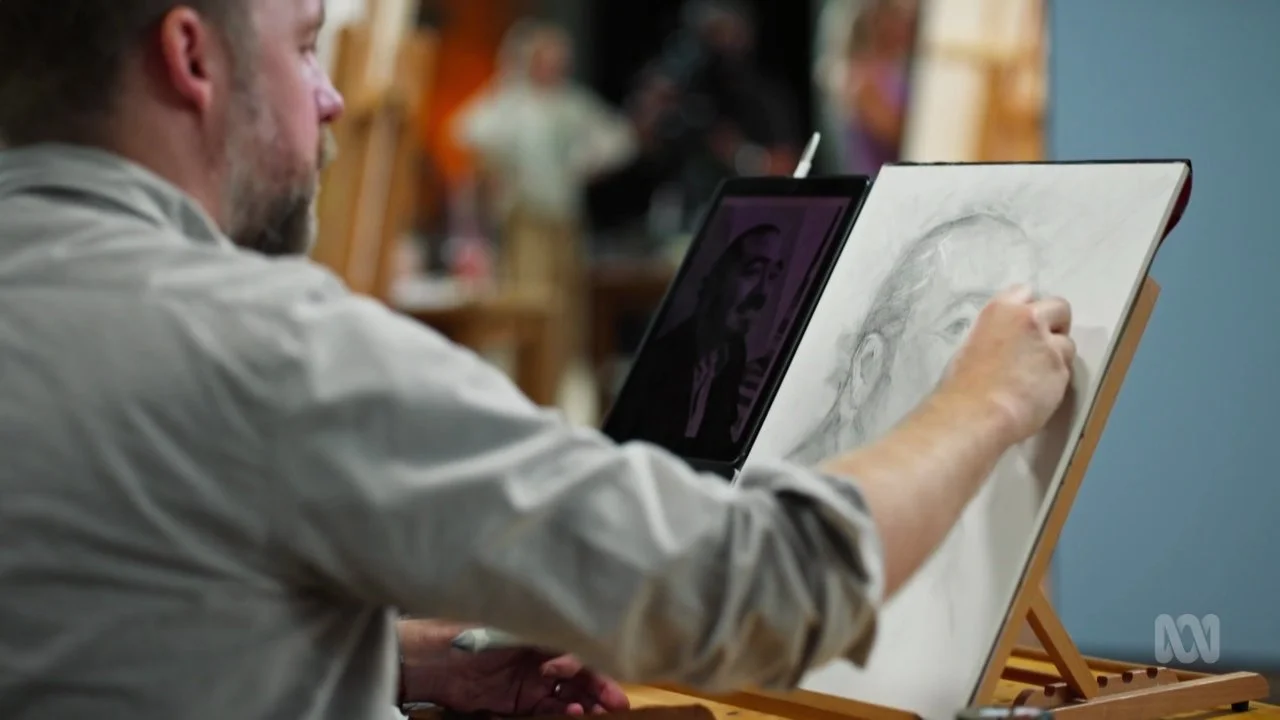
Yours truly with a reference on hand.
Portrait Artist of the Year is not a life drawing class. There’s no agreed upon structure where the model poses for 20 minutes, everyone has a break, then the pose is resumed for another 20 minutes. At the easel you can feel the movement of the TV production machine all around you; it’s an altogether different energy that’s unlike a traditional art studio, or creating at home, or in any familiar space.
The sitter is not a professional art model. They are a celebrity, or an otherwise public figure, and as much as they are there for the artists (and I’ve no doubt they accommodate them as best they can), they are also there for the cameras; they are there as entertainment. In the PAOTY environment, the sitter is also there to speak to the show’s hosts and producers, to give reactions and moments and comments, and they’re going to move away from your preferred pose as they do so. They are not just there to abide the three artists before them, but the needs of the director and producer and the entire filming crew around them.
The filming space is not free from interruption. The show’s producers, or the presenters, or the judges, will come over to tee up a conversation and ask questions at any moment. There are moments of visual interruption; maybe a camera will move inward to obscure the view between you and your sitter. And, of course, there’s the four hour limit, a marker that presents an interruption of time: no matter where you’re at with your piece, as soon as it’s up, it’s tools down and be damned if there’s a hundred little things you could fix with another five or ten minutes. In the real world sometimes art takes as long as it takes. In Portrait Artist of the Year, it has a ticking clock.
So it’s against all that, that artists might make use of a reference photo to assist their process. It’s similar to how we might see an artist use gridding to expedite blocking in and proportions, where in the real world it’s an approach they may not even use in their regular practice. A photo offers some level of stability and assurance in an unpredictable and unfamiliar environment.
But there’s also another reason.
And it’s here that we look at what Portrait Artist of the Year is.
In the same way that an artist will (or should?) approach a portrait away from a television production, Portrait Artist of the Year invites its artists to capture and convey their subject’s essence, their personality, their story. What sort of person are they? What feelings can this piece evoke? It’s not just about technical execution, but a demonstration of mood, of tone, of an understanding of their sitter.
Sometimes, the way to do that is to work with the pose you want, rather than the pose you get.
A reference image gives you control over the angle of your sitter. On the day you get assigned a spot, and that’s down to luck. You don’t get to pick if you’re at the sitter’s left, right, or front on. So what happens if you’re off to the side but you want to portray their commanding energy with a pose staring right at the viewer? Or conversely, maybe you’re given the centre easel but you want to portray them in profile. Hello reference image: they pose, you shoot, and your sitter’s story can be told. In the UK series I’m reminded of artist Eleanor Johnson who was placed to the side of actor Russell Tovey, but worked from a photo taken straight on - it won her the sitter’s pick and the overall episode.
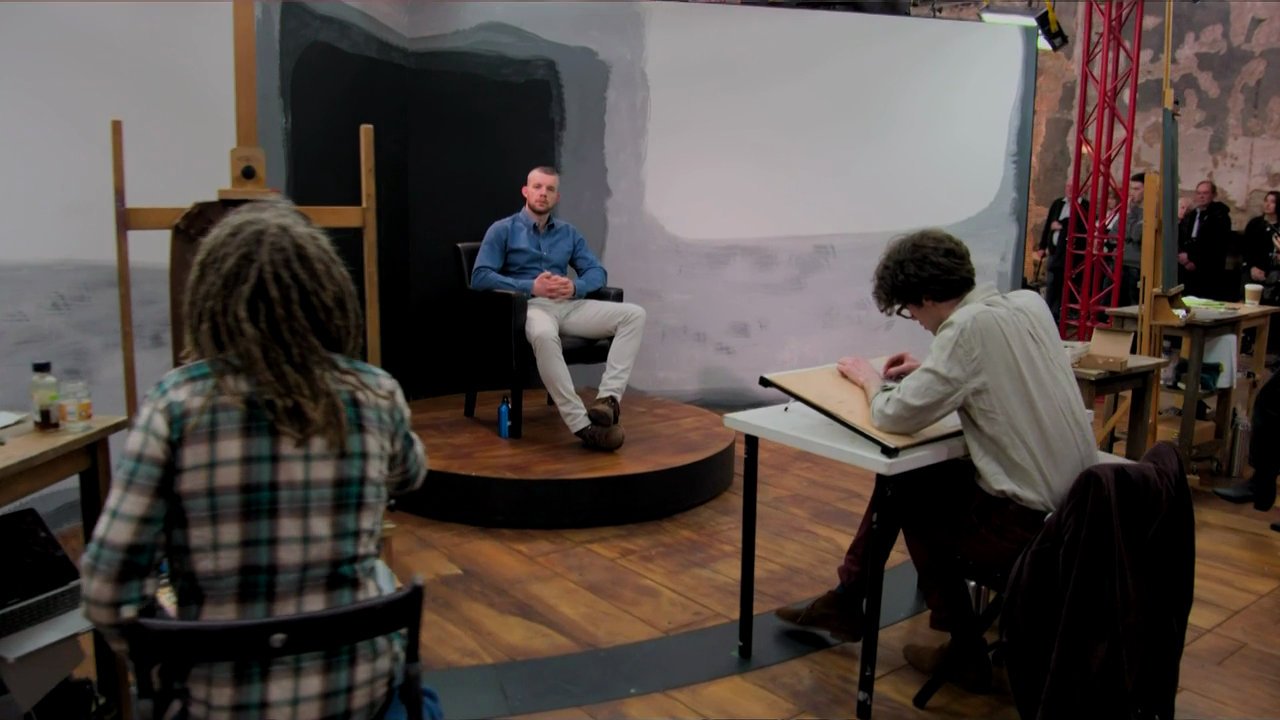
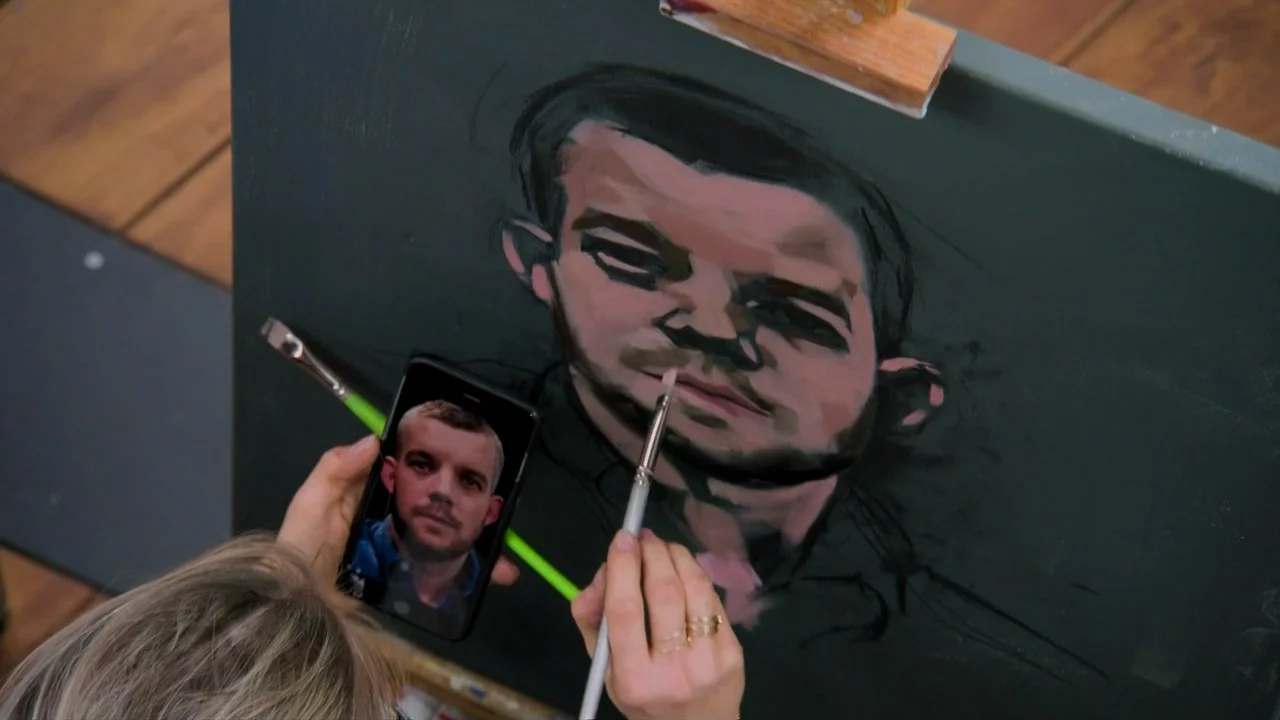
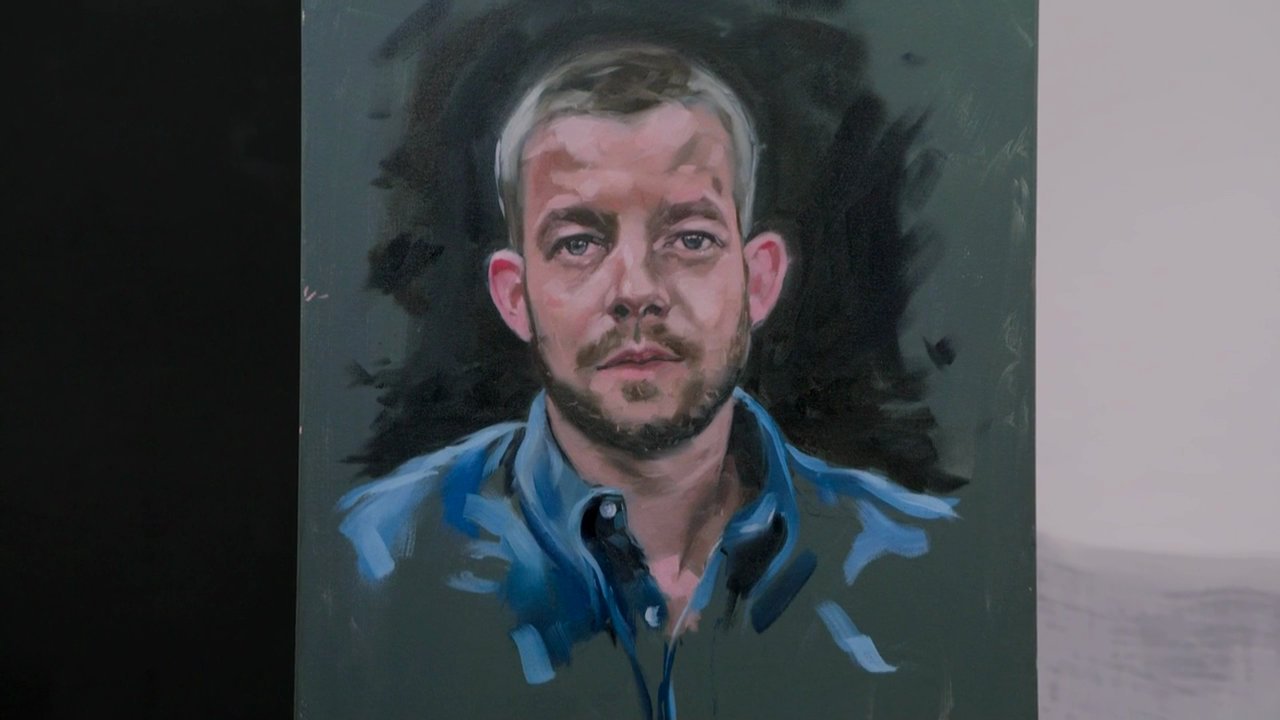
The location, the photo, and the resulting artwork.
Sometimes a reference’s usefulness comes not from control, but from spontaneity. With the luxury of rapid burst shots, maybe a sitter’s personality shines in that very brief moment where you captured a smile or glance that only lasted for a millisecond, but speaks volumes. Maybe it’s a captured moment where their eyes just happened to glance at a certain direction, or maybe you’re an artist who’s tapping into the energy of a joyful sitter and you’re up for the challenge of portraying them in a full-mouthed smile, or a moment of laughter. From life, these options either become eminently more difficult, or are not available to you. From a reference, you at least have that choice.
However, there needs to be moments of compromise, and to be open of one approach to the next. Working from life will naturally lend a certain energy to a piece, perhaps owing to the slight natural movements of the sitter. It prevents things from looking too rigid or feeling too staid; the process of always having to make adjustments, of balancing with a rocking boat, can add to an overall work. I once had a conversation with an artist who said she can tell immediately if a portrait has been painted solely from photographic reference. So working from life can add a unique something.
An artist should also be aware of the unintended effects of technology. In episode 7 of our Australian series, the semi-finals, we saw artist Anna-Caren Goosen making adjustments to the proportions of her painting of Dr Karl Kruszelnicki’s hand, the slight distortion inherent in a phone camera’s lens making things appear slightly off. Unless it’s a photographic effect you’re specifically looking to emulate - say, an exaggerated fish-eye lens - it is important to be mindful of how a phone image can impact a portrait.
Perhaps the ultimate insight is best found in someone who’s been there and done that both ways. Artist Hannah Broadhead appeared twice in the UK series of Portrait Artist of the Year - in 2023 she painted dancer and TV celebrity Shirley Ballas from life, while in 2025 she had a photo reference on hand to paint comedian and writer Fatiha El-Ghorri.
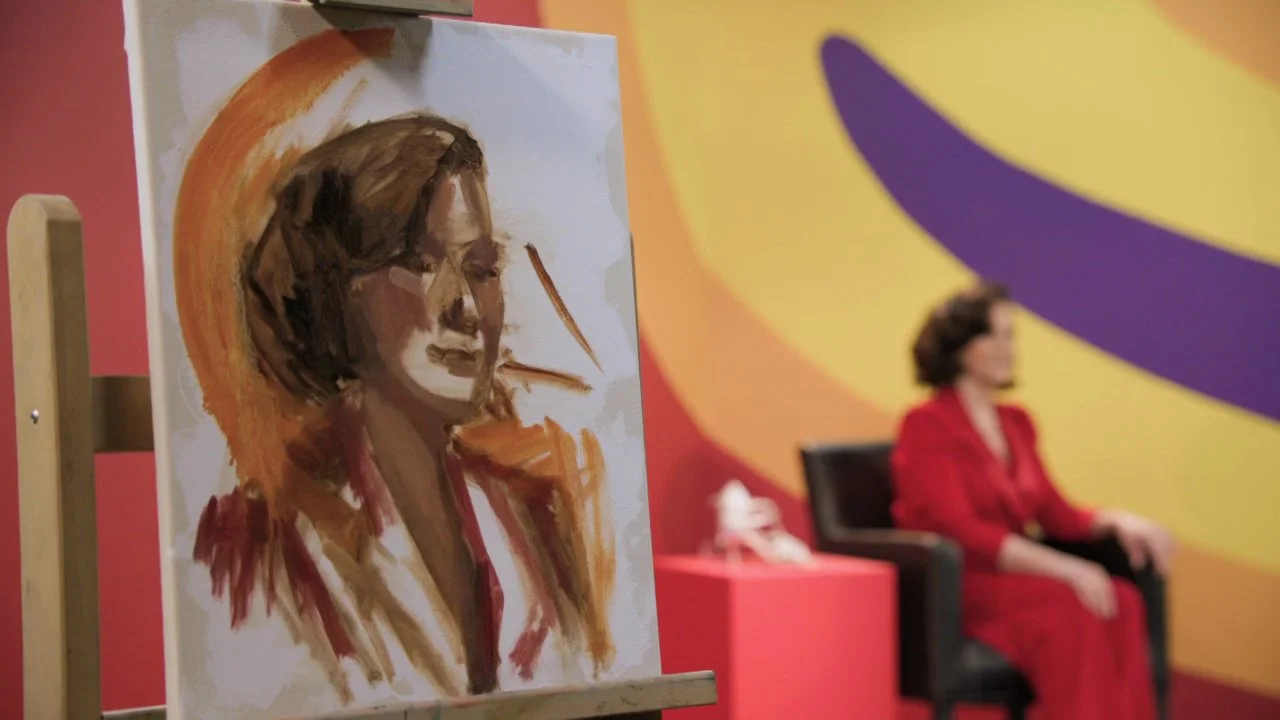
In the midst of painting Shirley Ballas from life.
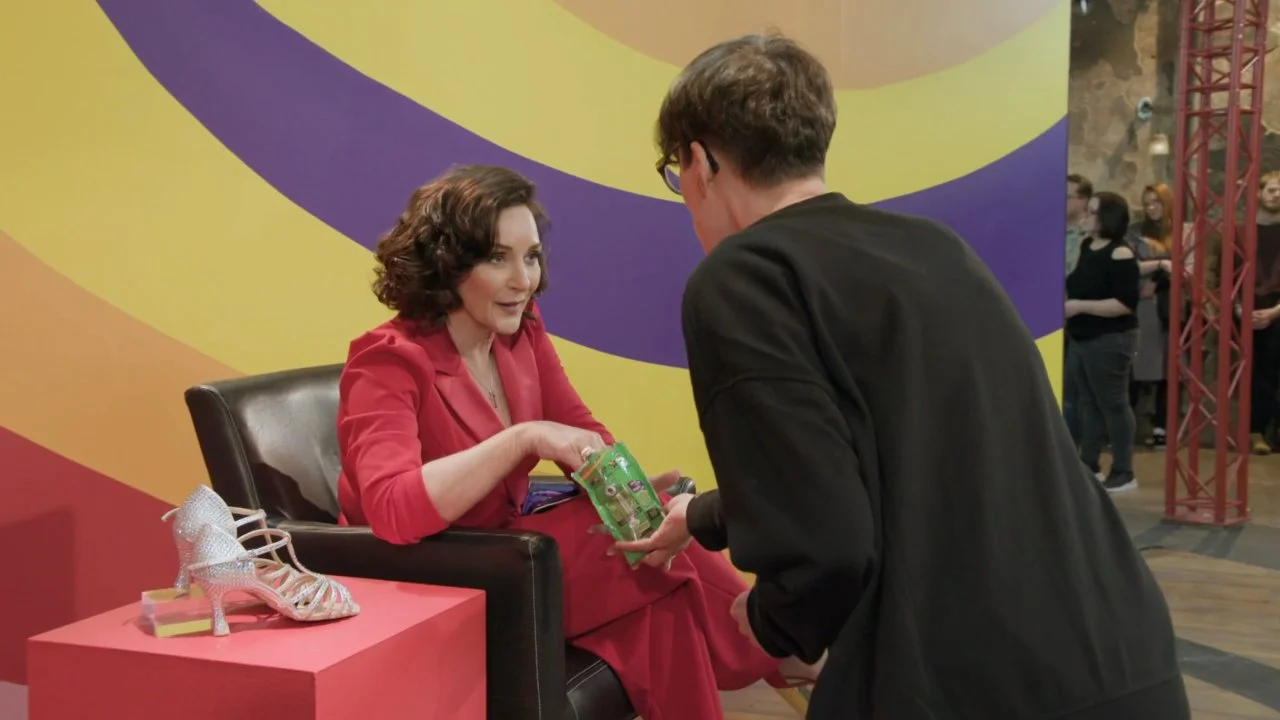
Hannah totally not bribing the talent with a sweetie.
“I did a lot of practice from life beforehand in the weeks running up,” Hannah says of her 2023 appearance. “However, what I wasn’t prepared for on the day was the adrenaline that made my senses heightened, which changed the way I painted. Time felt quicker, so brush marks were more rushed. Plus the movement of the sitter also meant I couldn’t work when they were being filmed and interviewed, so it worked out I had less time than others [who used a photo].
“The second time, I came up with a formula. Using a reference image, I could rely on that to start me off, then refer to life when I needed to. It kept the adrenaline a bit more in check as it meant I had a checklist, something I could work through methodically. So in the weeks before I was able to work to a formula and that’s what I practiced. It also meant that I was in control, not the show. I referred to the sitter for skin tones and clothing colours, but since my main pose was decided by the photo, it gave me freedom to enjoy the painting aspect more and get a better likeness.”
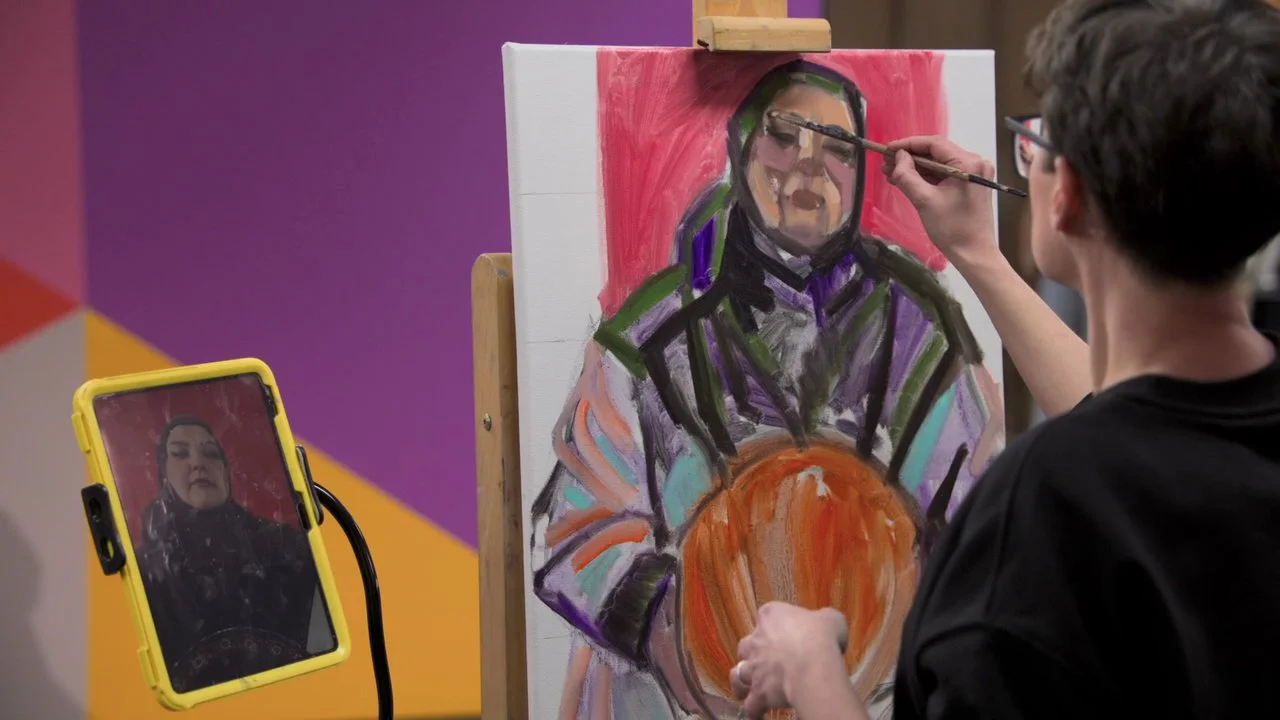
Hannah using a reference for her painting of Fatiha El-Ghorri.
The sitter is right there. Why are they working from photos?
Just as Portrait Artist of the Year demonstrates art’s countless styles, so too does it demonstrate there’s no one way to go about it. Along with the viewfinders and mirrors and mahlsticks and proportional dividers and all manner of additional tools available to them, a reference image can sometimes be the key to helping an artist bring their work to life.