This is part 4 of a series that looks back at my art journey and recounts the experience of being on Portrait Artist of the Year. Part 1 can be found here. Part 2 can be found here. Part 3 can be found here.
Each time I find myself talked into riding a rollercoaster, there’s a feeling that happens after being strapped into the seat, having it checked by the attendant, and waiting for what feels like an eternity. It’s the feeling when that first lurch forward kicks things into motion - the moment it becomes clear that it’s too late to back out now, and that you’re entirely at the mercy of the ride, and whatever twists and turns and corkscrew loops may happen.
“Your time starts now.” This was the same feeling.
The clock was ticking, Portrait Artist of the Year had begun. As Emmaleen raced towards Adam to be first to get her reference photos, I tried not to think about the spotty night’s sleep I’d had, or the fact it was 7:30 in the morning and when had I ever drawn anything worth a damn at 7:30 in the morning. I reminded myself of the practice I’d done. I kicked my artist brain into gear, thinking of ways to frame my subject, different angles, compositions. The rollercoaster was moving. Time to move with it.
Phone in hand, I approached Adam and introduced myself. I envisioned a portrait of Adam looking towards the right of the frame. Sitters also bring with them an item of importance, and here it was a Chinese lion head mask. I asked Adam to recall the memories it brought as I snapped my photos (Side note: working from photos on PAOTY is a topic worth giving more attention to, and one I’ll explore further in a future standalone post (UPDATE: It’s here!)), hoping I could link the recollection of joy with the expressions it produced.
Thanking Adam, I returned to my table. I took a deep breath and picked up a pencil. “Here we go…” I whispered, and I started to draw.
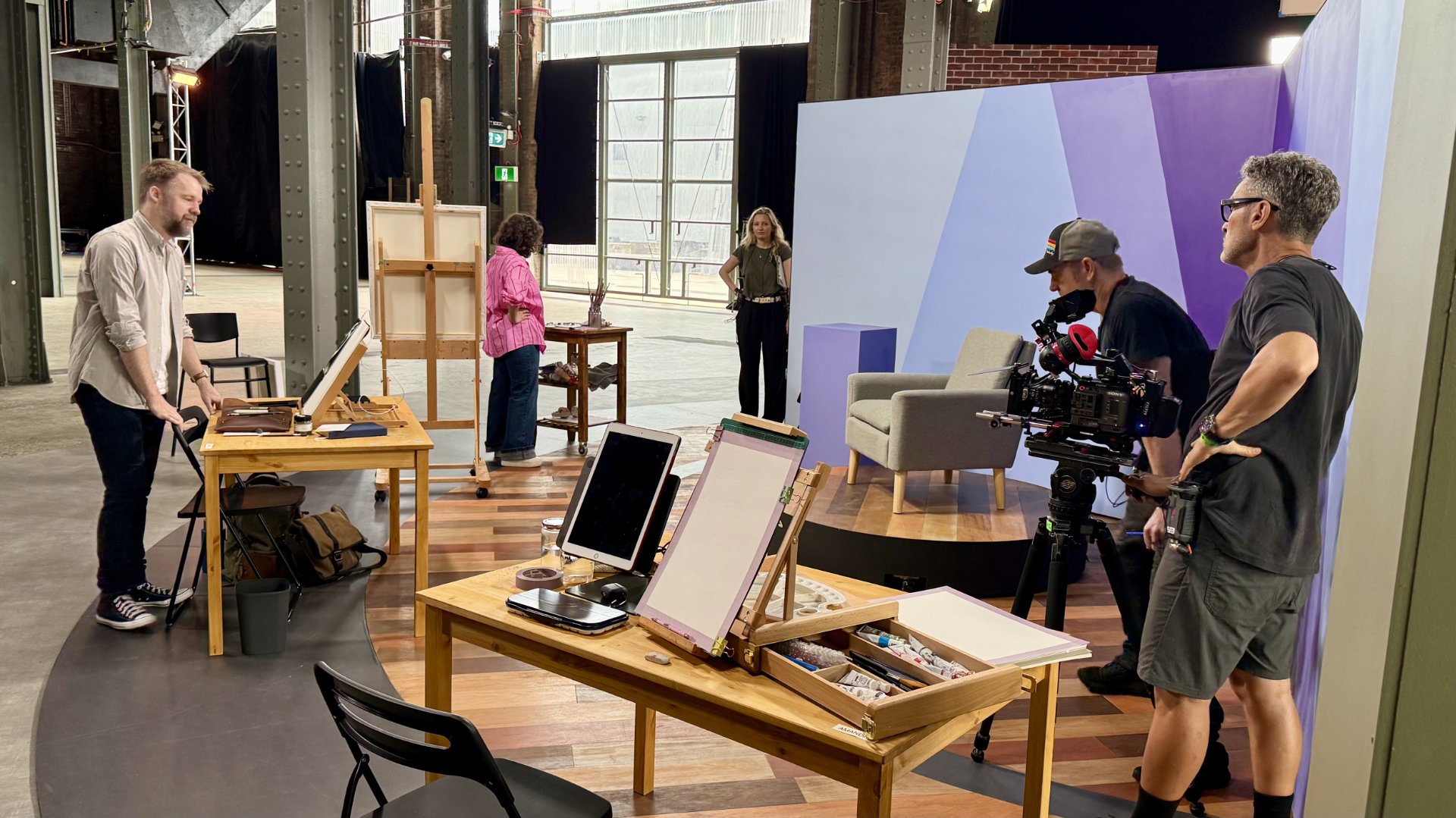
The calm before the storm.
They say it’s better to have it and not need it, than to need it and not have it. It was partly that thought that had me pack every conceivable graphite and graphite-adjacent tool I owned into my PAOTY go-bag. But maybe in acknowledgement of the fairly minimalist set of supplies in regular use, I think I brought the kitchen sink so it would look more interesting on camera.
Here’s what I used on the day:
Blackwing Pearl pencil
Blackwing Matte pencil
Coates Graphite Powder
Blending stump
Kneadable eraser
Pencil sharpener
There’s all manner of wonderful graphite art made by utilising the full gamut of H and B pencils and sticks, and maybe one day I’ll find my way towards exploring some of it. But for my current practice, and one of the first tips I’ll give to anyone wanting to learn to draw, sometimes less is more. I find the Blackwing Pearl useful for the initial block-in and light shading, then use the darker value of the Matte for the bulk of the drawing.
That was the process I followed here. Arm outstretched, pencil held at its end like a magic wand, I established a rough formation of all the major shapes. It feels weird to reduce such a wonderful and warm personality like Adam Liaw down to shapes, but that’s how every portrait starts. Once you’ve got the foundation there, then you can start to work out how you can turn those shapes into life, emotion, feeling.
Every portrait benefits from tuning into the unique elements of your subject. While I had 90% figured beforehand that my portrait would be a head and shoulders composition, there should always be a 10% that remains open to the possibility of the unknown. What if my sitter was someone whose body, or hands, were part of their character? Things like that need, and deserve, to be included.
For me, for Adam, it was the warmth in his face. On set he was a genuine down-to-earth person; humble, sincere, keenly observant. I wanted those qualities to be the essence of his portrait.
Some artists will bring headphones to pop on and tune out the distractions around them. They’ll hit up their favourite playlist and let the music guide their focus to the canvas. I brought headphones for this very reason, but I didn’t end up using them; particularly since I was using a photographic reference, it seemed almost like a wasted opportunity to have an eminent food culture personality right in front of me only to tune him out entirely.
So throughout the day, here and there, we chatted. I asked him, as I’m sure others have done before me, about the impact that winning season 2 of MasterChef had on his life, and the changes it brought to his career trajectory. As someone in a career crossroads, looking for the next signpost, I was interested to know how he gauged making the jump from law to food. It wasn’t as much of a leap as you might think, he told me - at the end of the day, you’re still managing emails, still balancing schedules, still taking care of the admin. At the end of the day, it’s still a job.
It’s probably no surprise to learn that a TV production will film more than they use. With the cameras rolling from those wee early hours through to the setting of the sun, there’s a lot that’ll be cut down and cut out to fit a four-hour art session into a 45 minute episode. So rather than repackage a more verbose version of what the episode has already shown, I thought I’d visit some of the parts we didn’t see.
My first interview was with Miranda. None of it made it to air. But she was super friendly as she came in somewhere in the first hour to ask about my art background, what it’s like being a husband who draws to a wife who paints. I said I find it helpful - Amanda’s someone who can bring a second set of eyes to my work, to help me see things outside my own head. As I was saying it I was reminded of author Stephen King and his writing relationship with his wife Tabitha. (It was she who pulled a binned manuscript out of the trash and suggested it was worth revisiting. That manuscript was “Carrie”. That decision would change his life.) Tabitha is King’s sounding board, his first port of call for every piece of writing. I think every artist needs their Tabitha. I’m just lucky that mine is Amanda.
One hour turned into two, and judge Abdul Abdulla came over. It was his turn for a chat. Abdul asked if I was going to incorporate the item Adam had brought in, the lion’s head mask. I said I was looking to evoke it through shapes in the markmaking that I would apply throughout the piece: big arched streaks, something bold and playful, to couple the gaze of Adam looking into and recalling the memories the item provided. In the same way that those comments didn’t reach the edit, I’m not sure my markmaking fully achieved this. It was too reserved. There was some suggestion of it in the background, but not to the extent I had envisioned.
In hour three I caught myself looking at the blue visual diary that I’d placed on my desk. Or, more specifically, the handwritten letter I’d placed upon it, the name on the envelope addressed to me. As I continued my drawing I looked at that envelope and tried not to think about how it was used in a way that was not intended, seen by an audience it was not meant for.
Let’s backtrack slightly. In the leadup to filming day, Amanda suggested we should write each other letters. “We give them to each other but we don’t open them yet,” she said. “We’re both going to be nervous. So when there’s a quiet moment during filming, we can read them, to give each other some words of support.”
We wrote, exchanged, and stored our letters. And during a brief moment of downtime in the morning, after we had set up our easels and prepared our materials, Amanda opened my letter to her, and so I did the same.
Stu, the producer, noticed. “What have you got there?”
Uh-oh…
He turned to a nearby cameraman. “Hey, they’ve written each other letters. That’s great. Hey, can you get a shot of that?”
And so as the camera aimed over my shoulder, I read through the words that Amanda had penned for me, before the camera went over to her and peered at my letter to her. Our loving, private words of affectionate support, our pet names for each other, were now part of filmed content to be broadcast to the nation.
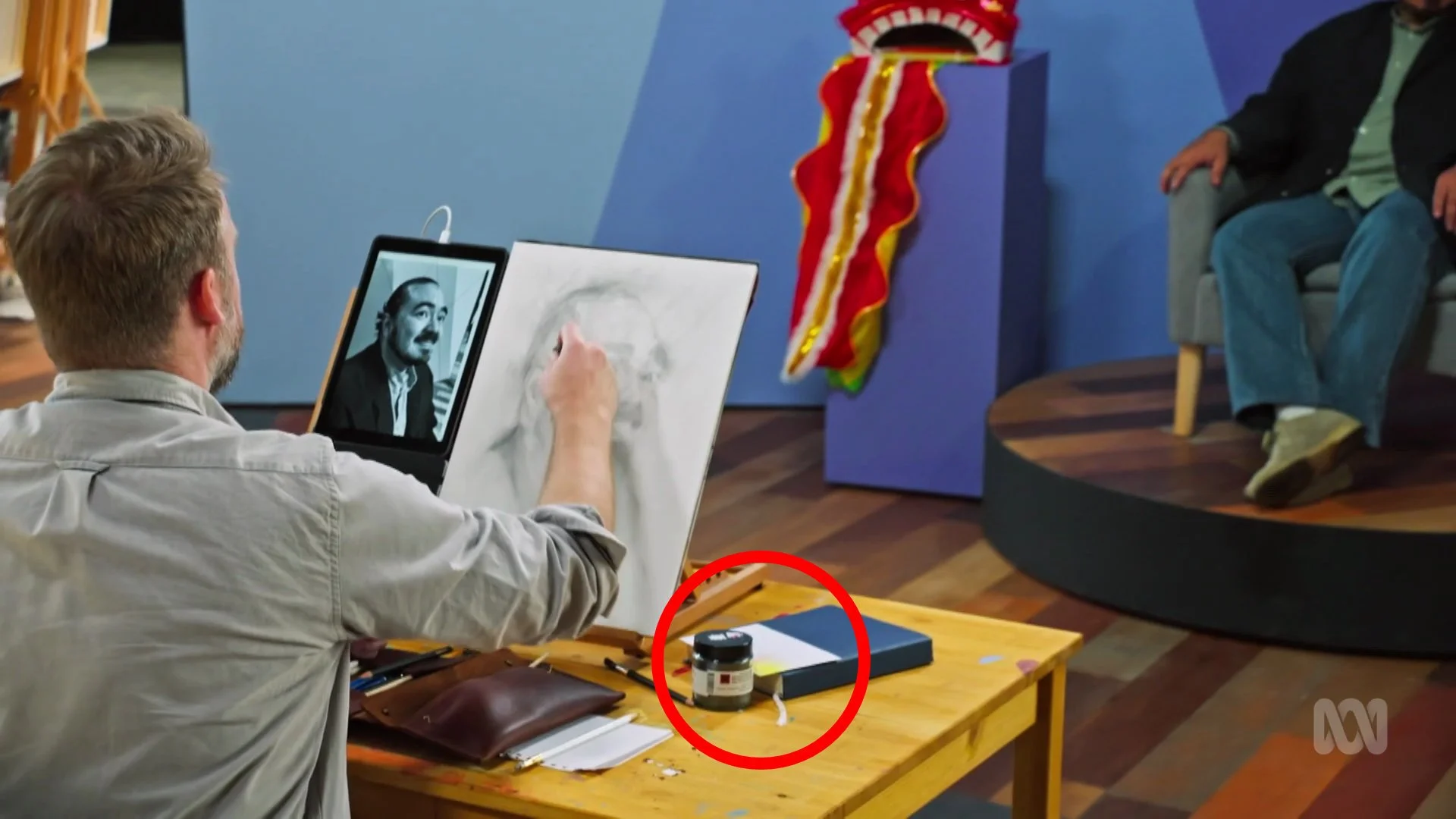
iykyk
As hour three turned into hour four I tried not to think of what the final cut of this experience might look like. Future me would be thankful that the team in the editing room would ultimately decide to keep this moment to the two people for whom it was intended.
“You have one hour to go!”
The time call for the final hour echoed throughout, and something inside me shifted. With 60 minutes counting down, my portrait’s biggest decisions locked in and taken care of, I remember thinking to myself “It’s too late now, let’s just have fun with it.” And in a way, I felt freer than in any of the 180 minutes that had preceded it. I went in to focus on detail in the eyes, dial up some areas of contrast, add some more markmaking. It was during this block that Luke and Miranda refilmed some time calls to camera, with a producer giving us artists a heads up not to mistake their calls of “two hours left!” for the actual time remaining. I’m sure we could have all done with plenty more.
When those fateful four words were called out, however, they were for real:
“Your time is up!”
Applause, a weight lifted. Deep breath. Arching my shoulders back in a much-needed stretch. It all happened at once as I put down my pencil and stood from my desk, the portrait as complete as it was allowed to be.
I went over to hug Amanda. “We did it.”
“Yes, we survived.”
Out came a trio of Bunnings umbrellas, and production people used them to shield the sitters from our work as they took their leave. I couldn’t help but smile, appreciating the dedication that ensured the easel-turning reveal, when it would come, would be a genuine moment.
And then, all we could do was wait.
To be continued…